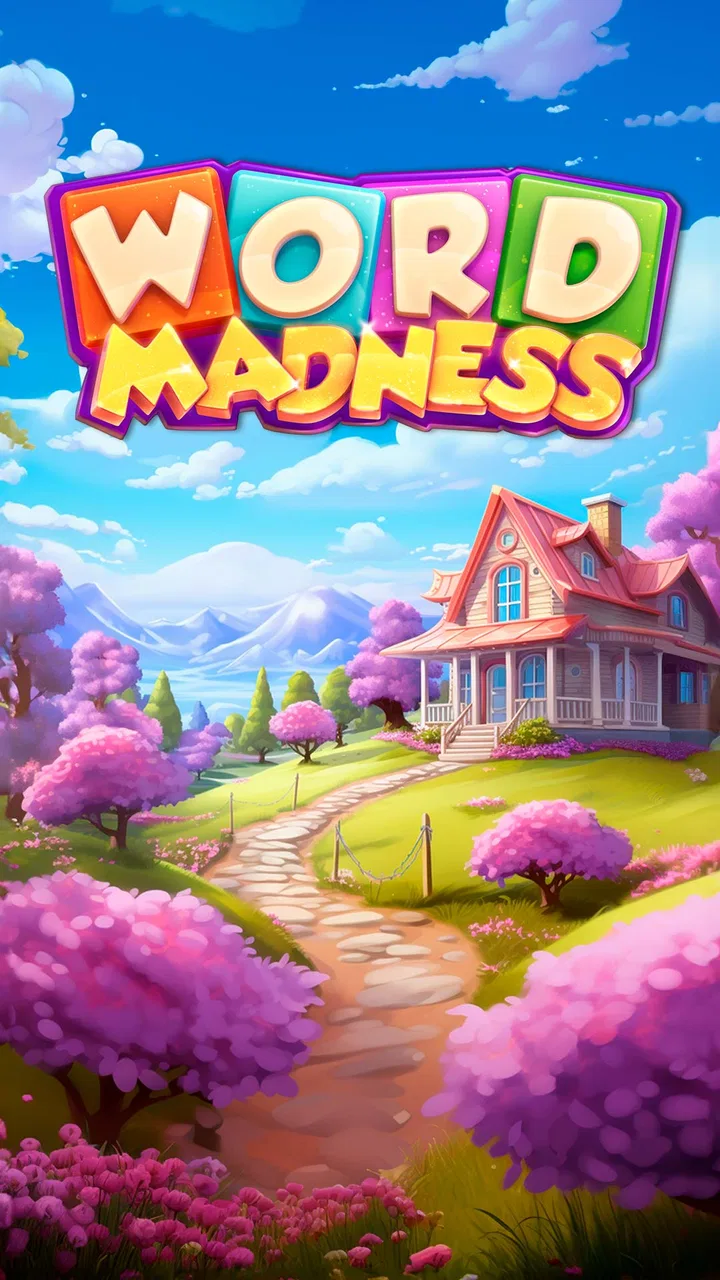
Word Madness
- 4.9
- Rating
- 1.00M
- Installs
- Free
- Price
 Analysis by App-foxy
Word Madness is the kind of word game I can open for a few minutes while waiting for an appointment, then keep playing longer because each puzzle gives me a small reason to continue. Developed by Mad Brain Games LTD, it focuses on crossword-style challenges rather than fast reactions or complicated controls. I found the appeal fairly immediate: the screen asks me to think, test a word, and use the letters I already have to narrow down the answer. It feels approachable for casual players, but it can still make an ordinary break surprisingly absorbing.
The game is free to download and suitable for Everyone, which makes it easy to recommend to families or to someone who wants a gentle mental exercise without committing to a large adventure or strategy title. Its store summary presents the idea of solving crosswords to challenge the brain and build vocabulary, and that is a fair description of the central experience. What matters in practice is how comfortably that idea fits into daily use, how much patience the puzzles require, and whether the game remains pleasant when I play repeatedly.
How Word Madness feels during everyday play
My first impression is that Word Madness is built around a simple loop: inspect the available letters and clues, form possible answers, and keep working until the puzzle becomes complete. That simplicity is useful. I do not need to learn a long tutorial or remember a complicated control scheme before starting. The challenge comes from language itself, so the difficulty depends more on vocabulary, attention, and willingness to try alternatives than on reflexes.
You May Also Like

 Blood Strike: 2.5 Anniversary
Blood Strike’s Loadouts Turn Every Drop Into a Tactical Gamble
A close look at Blood Strike’s custom loadouts: how fast access to signature weapons reshapes its battle royale rhythm, rewards preparation, and narrows the gap between fights.

 Pandora - Music & Podcasts
Pandora’s Music Is Easy to Start, but Harder to Recover
Pandora’s strength is its low-effort path from a seed to a station. Its weak spot is how much confidence it asks you to place in connection, setup, and quiet recovery.

 8 Ball Pool
 Is Built on Rivalries, Rematches, and Routine
A close look at the rivalries, rematches, shared routines, and unanswered safety questions that turn a quick pool match into a persistent mobile community.

 Samsung Music
’s Quiet Strength Is Playing What You Already Own
Its reach comes less from spectacle than from dependable access to a personal library. That simplicity is both the app’s strongest retention engine and its ceiling.

 AccuWeather: Weather Radar
AccuWeather Review: A Quick, Clear Forecast for Everyday Decisions
For everyday plans, the best forecast is the one you can understand quickly. AccuWeather makes rain timing, radar, and local conditions easy to act on, with a few trade-offs.

 Hill Climb Racing
Why Hill Climb Racing Still Turns Crashes Into One More Run
A tiny car, a bumpy hill and one more upgrade: Hill Climb Racing keeps resurfacing because its simple chaos makes every near-miss feel personal.
More From Our News Desk



That makes it a good companion for short sessions. I can play while having coffee, during a quiet commute, or when I want something more active than scrolling through social media. The individual actions are easy to understand, but the mental process is not always easy. A familiar word can stay hidden simply because I am approaching the clue from the wrong direction. When the answer finally appears, the satisfaction comes from recognition rather than spectacle.
I also like that the game can serve different moods. If I am tired, I can treat it as a relaxed vocabulary exercise and solve only a little. If I am more focused, I can stay with a difficult puzzle and examine the possible combinations carefully. That flexibility is more important than it sounds, because many word games are either so casual that they become forgettable or so demanding that they feel like homework. Word Madness sits somewhere between those extremes for me.
Speed expectations and the rhythm of a session
Word Madness is not a game where speed is the main reward. The useful kind of speed here is how quickly I can get into a puzzle, understand what it wants, and make progress without unnecessary friction. Its crossword format naturally supports a measured rhythm. I spend more time thinking than tapping, so the game feels responsive in a mental sense even when I am not racing against a clock.
That distinction matters when comparing it with other mobile word games. A timed anagram game can create excitement through pressure, while a word-search title may let me scan a crowded board very quickly. Word Madness is better suited to players who enjoy pausing over a clue. If I want a burst of frantic competition, this would not be my first choice. If I want to exercise recall and pattern recognition at my own pace, the design makes more sense.
One practical tip is to avoid guessing randomly as soon as I get stuck. I have better results when I first identify short, obvious words and then use the remaining letters as a filter. That approach turns a vague puzzle into a series of smaller decisions. It also helps me notice how one solved word can reveal the structure of the rest of the board. The game rewards organized thinking more than tapping every possible combination.
Another useful habit is to treat unfamiliar answers as vocabulary discoveries rather than failures. A word that does not come to mind immediately can expose a gap in my everyday vocabulary, especially when the surrounding letters make the answer look obvious afterward. Players who enjoy learning through repetition may appreciate this aspect. Players who prefer only common, instantly recognizable words may find some moments less satisfying.
What happens during heavier use
The most demanding moments are not likely to come from graphics or rapid animation. This is a word-focused game, so the heavier load for the player is cognitive: long sessions, repeated puzzles, and the gradual fatigue that makes simple clues look harder. After playing for a while, I notice that I start forcing familiar patterns instead of considering less obvious possibilities. Taking a short break is often more effective than using another guess immediately.
That makes Word Madness unusual compared with visually intensive mobile games. It does not ask me to manage a detailed world, coordinate several abilities, or react to multiple moving targets. The experience is therefore easier to fit into modest use, but it can also feel repetitive if I expect constant visual variety. The main source of freshness has to come from the puzzle content and from my own changing ability to recognize word patterns.
For a longer session, I would suggest setting a personal stopping point rather than waiting until the game becomes frustrating. A useful routine is to solve a few puzzles, note the kinds of words that slowed me down, and return later with a clearer mind. This is not a feature claim; it is simply the way I get more value from the format. The game works best when I treat it as a compact thinking activity, not as an endless test of endurance.
There is also a trade-off in the free-to-play structure. Word Madness costs nothing to start, but in-app purchases range from $0.99 to $99.99 per item. That broad range means I would pay attention to what I actually need before buying anything. A player who is comfortable progressing without extras may find the free entry sufficient, while someone who wants to remove every interruption or obtain additional assistance should consider the cost carefully. I would not spend automatically just because a puzzle is difficult.
Reliability and recovering from interruptions
For a game like this, reliability is less about maintaining a real-time connection to other players and more about preserving a calm puzzle session. I value being able to put the phone down, answer a message, and return without feeling that I have lost the thread of my thinking. The crossword format is naturally forgiving in that respect because it does not depend on split-second timing. Even when an interruption breaks my concentration, I can inspect the board again and rebuild my approach.
Recovery is also easier when I use a written mental process: start with completed words, identify the remaining letter groups, and test the most plausible answer rather than repeating the same guess. That method gives me a clear way back into a puzzle after a pause. It is one of the understated strengths of this type of game. The challenge is self-contained, so I am not punished in the same way I might be in a competitive match.
At the same time, a player should not expect the emotional recovery to be automatic. When I am stuck, the simplicity of the interface does not remove the frustration of seeing a nearly finished puzzle refuse to resolve. Hints or other assistance may be tempting in those moments, but I prefer to wait, change my perspective, or leave the puzzle for later. The best experience comes from using help selectively instead of turning every obstacle into a purchase.
The game has reached a substantial audience, with over 1 million installs, and it holds a 4.9 average from around 51 thousand ratings. Those figures suggest strong player approval, but they do not guarantee that every person will enjoy the same pace or vocabulary choices. I read them as a sign that the core concept works for many users, not as a reason to ignore my own preferences. A popular word game can still be the wrong match for someone who wants action, story, or multiplayer competition.
Device constraints and practical expectations
Word Madness requires Android 10 or later, so compatibility is an important first check for anyone using an older phone or tablet. On a supported device, the game’s word-centered design should be easier to accommodate than a visually demanding three-dimensional title, but I still would not assume that every handset will feel identical. Screen size, touch accuracy, available storage, and the general condition of the device can all affect comfort.
A larger screen can make a meaningful difference for players who dislike crowded letter layouts or who spend a long time examining clues. On a smaller phone, I would use a lighter touch and avoid rushing between possible answers. The game is not about physical precision, but an accidental tap can interrupt the reasoning process. This is especially noticeable when I am focused on a nearly complete puzzle and want to preserve a careful sequence of thought.
Resource demands are best judged conservatively. Word Madness does not present itself as a graphics-heavy action game, so I would expect the main strain to come from ordinary mobile use rather than intense rendering. Still, I would close unrelated apps if my phone is already struggling, keep the operating system within the supported range, and avoid judging the game from a device that is low on space or generally unstable. Those steps help separate app behavior from wider handset problems.
Battery expectations should also be realistic. A quiet word game is a better fit for battery-conscious play than a title built around constant animation, but every active app uses some power. I would use it comfortably during short breaks and keep an eye on battery health during long sessions, especially on an older device. The important point is that the game’s appeal does not depend on pushing the phone hard; it depends on whether the puzzles keep my attention.
Who will enjoy it, and who should choose something else?
I would recommend Word Madness to someone who likes crossword puzzles but wants a phone-friendly format that can be opened without preparation. It is also a sensible choice for players who enjoy improving vocabulary indirectly, because solving a puzzle encourages me to remember unfamiliar words and recognize their structures later. Families may find the Everyone rating reassuring, although younger players will still benefit from guidance when a clue or answer is unfamiliar.
It suits people who prefer solo play, quiet concentration, and flexible session lengths. It is particularly useful as a replacement for passive phone habits: instead of refreshing a feed, I can spend a few minutes working through letters and clues. That everyday use case is where the game feels strongest. It gives me a small mental task without demanding that I rearrange my schedule around it.
I would skip it if my main goal is a story-driven adventure, a competitive leaderboard, or a fast arcade challenge. I would also hesitate to recommend it to someone who dislikes word puzzles becoming difficult through less familiar vocabulary. The game cannot solve that preference mismatch. A traditional newspaper crossword may be better for a player who wants a slower, more deliberate ritual, while a timed word title may be better for someone who needs urgency and immediate feedback.
There is a further difference from paper puzzles: a mobile game can be more convenient, but the phone environment brings distractions and possible purchase prompts. I find the digital format easier to carry and restart, yet it does not have the same screen-free calm as a printed crossword. Choosing between them depends on whether convenience or a quieter offline routine matters more to you.
My performance verdict
After looking at the way it fits into short sessions, longer stretches, interruptions, and different devices, I see Word Madness as a focused and accessible word game rather than an all-purpose mobile pastime. Its performance appeal comes from restraint. It asks the phone to present a puzzle and lets the player supply the real effort. That makes it easier to pick up than many larger games, while also making its limitations more visible when the puzzle format begins to feel repetitive.
The current version is 21.68.1, and the game was released on September 1, 2022. Those details place it in the category of an established mobile title rather than a brand-new experiment. Mad Brain Games LTD has built the experience around a clear idea, and the strong rating and install count show that the approach has found an audience. I would still judge it by the quality of the individual sessions I want, not simply by its reach.
My advice is to install it if you want a free crossword-style game for quiet, repeatable practice and you are comfortable with a slower pace. Begin without spending money, learn how the puzzles fit your vocabulary, and use a structured solving method when you get stuck. If the game becomes part of your routine, decide later whether any optional purchase genuinely improves your experience. The best reason to play Word Madness is the small, satisfying act of figuring something out, not the promise of constant excitement.
Overall, I think it is an easy recommendation for casual word-game fans, language learners who enjoy informal practice, and anyone looking for a thoughtful break from more demanding apps. I would not call it ideal for every player, but its combination of simple access, manageable device expectations, and vocabulary-focused play gives it a clear purpose. For me, Word Madness works best as a pocket crossword companion: calm enough for everyday use, challenging enough to hold my attention, and honest about the fact that the real action happens in my head.
FAQs for Word Madness
01What is Word Madness and how does it work?
Word Madness is a fast-paced word puzzle game designed for both Android and iOS platforms. Players are tasked with forming words from a set of scrambled letters within a time limit. The game includes various levels of difficulty, challenges, and multiplayer options to keep users engaged and improve their vocabulary skills.
02Is Word Madness free to play, or are there in-app purchases?
Word Madness is free to download and play, offering a range of levels and features at no cost. However, it includes optional in-app purchases for items such as extra hints, additional themes, or ad-free experiences. These purchases can enhance gameplay but aren't necessary for progression.
03Does Word Madness require an internet connection?
Word Madness can be played offline, allowing users to enjoy the game without an internet connection. However, certain features like multiplayer modes and daily challenges require online connectivity to function. Offline mode is perfect for users who want to play on the go without using mobile data.
04What age group is Word Madness suitable for?
Word Madness is suitable for a wide age range, typically recommended for players aged 8 and above. The game’s simple interface and adjustable difficulty levels make it accessible for younger players, while its challenging puzzles and competitive modes appeal to older audiences seeking cognitive stimulation.
05How can I track my progress and compete with friends in Word Madness?
Word Madness offers a user-friendly interface for tracking progress through personal achievements and leaderboards. Players can connect through social media accounts to compete with friends, compare scores, and participate in multiplayer challenges. This social feature enhances the competitive aspect of the game.
Pros
- Engaging word puzzles keep your mind sharp.
- Variety of levels to suit all skill levels.
- User-friendly interface enhances gameplay.
- Regular updates with new challenges.
- Offline mode available for on-the-go play.
Cons
- In-app purchases can be quite expensive.
- Occasional ads disrupt gameplay flow.
- Limited hints can be frustrating for beginners.
- No multiplayer mode for social play.
- Graphics are simple
- lacking visual flair.

Word Madness
Gallery